

And....Zadar basketball
“The womb of basketball”
RETROPLAYERS
Antreas Tsemperlidis
6/26/20264 min read
On April 26, 1930, in the Italian-occupied city of Zadar, the team of the same name was founded. Six decades later, on its anniversary, the pride of the city would bring the championship trophy back to the place where “God created man and Zadar created basketball.”
The 1985–86 season remains in the history of the Yugoslav league as one of the most unpredictable, while at the same time it influenced the basketball of the Plavi and the national team during the few years the country remained united.
The transition in Yugoslavia had gradually begun in 1983, and by the 1985 EuroBasket in Germany, Krešimir Ćosić had almost completed the shift from his own golden generation to that of the new stars. The one who naturally stood out was Dražen Petrović, while alongside him were four of his teammates from the European champion Cibona: Sven Ušić, Mihovil Nakić, Andro Knego, and Zoran Čutura. However, the presence of the “Mozart” was not enough to prevent defeat by the old guard of Czechoslovakia in the quarterfinals and a seventh-place finish overall.
Although the result was clearly negative, the Yugoslav federation showed confidence in Ćosić and focused on developing and promoting young players. It should never be forgotten that any action by the federation was always based on the recommendations of the “Holy Quartet,” with the interest of the national team and Yugoslav basketball as a whole in mind.
The hopes were placed on the youth, and they did not disappoint. In August 1985 in Bulgaria, at the European Cadet Championship, the 17-year-old Plavi comfortably won the gold medal, defeating Spain in the final with 36 points from Radenko Dobraš. With Nebojša Ilić as top scorer and support from, among others, Toni Kukoč and Vlade Divac, the youngsters showed they had a bright future ahead and that clubs in the national league needed to give them a chance.
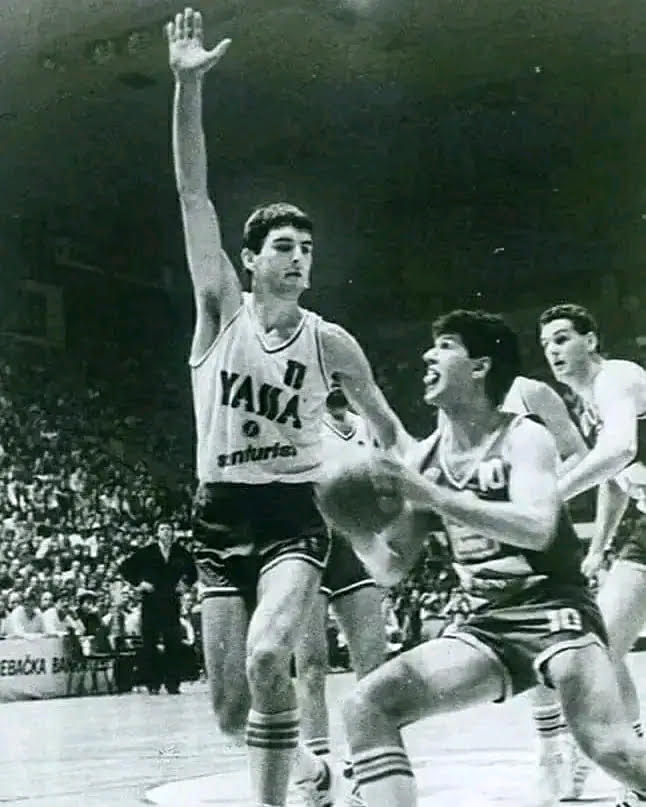
Thus, in September 1985, the twelve contenders entered the race for the championship, which had a clear favorite from the start: Cibona, led by the Petrović brothers. Even though coach Željko Pavličević could not rely on Aleksandar Petrović and captain Andro Knego due to military service, the European champions brought in the experienced Damir Pavličević and the talented Danko Cvjetićanin, who had surprisingly been released by Partizan.
The other title contenders? Red Star, coached by Ranko Žeravica, was nearly complete (only Zufer Avdija was absent due to military service). Zadar, led by Vlade Đurović, was without its top scorer Ivan Sunara due to injury and signed Milan Mlađan from IMT. As for Partizan, the departures of Boban Petrović and Svetislav Pešić made room for new blood such as Grbović and Savović, as well as the arrival of former rival Peter Vilfan from Olimpija Ljubljana.
The season began and quickly proved to be extremely interesting. By the fifth round, Dražen scored the controversial 112 points against Olimpija’s juniors, showing he was in phenomenal form throughout the season, leading Cibona from victory to victory.
The “Wolves of Tuškanac” finished the first half of the season undefeated and topped the standings with only one insignificant loss to Šibenka. Dražen scored 52 points in his former home, but Predrag Šarić’s 36 were enough for a 102–100 win. Even so, Cibona achieved something only Red Star in 1949 and Zadar in 1975 had done before—losing just one game. They also broke Partizan’s 1978 scoring record, averaging 111 points per game, with Dražen leading the way with 43 points per game—a true celebration of offensive basketball. Behind them finished Zadar with 15 wins and 7 losses, while the big surprise was Budućnost in third place, led by Duško Ivanović and a young fast-breaking talent named Žarko Paspalj.
All signs pointed to an easy playoff run for Cibona. Their European campaign, culminating in the Budapest final, only reinforced that belief. No one could imagine that Europe’s dominant team would fail to win the Yugoslav title as well.In the playoffs, Cibona eliminated Red Star and then Partizan, both in three games. Meanwhile, Zadar reached the finals more comfortably, sweeping Bosna and Jugoplastika. Despite this, Cibona remained the clear favorite. Đurović knew that to have any chance, he needed to limit their offensive flow. Petrović would score anyway, but the key was to slow the game down—and he succeeded from the very first match. In Game 2, played in Jazine, Cibona appeared without Petrović. The reasons remain unclear to this day. Zadar took advantage, tied the series 1–1, and forced a decisive Game 3. On April 26, 1986, Zadar’s 56th anniversary, the arena in Zagreb was packed. The game was tense and physical. Petrović received a technical foul early, while Arapović was ejected. Cvjetićanin led Cibona in the first half, but Zadar stayed close thanks to Stojan and Petranović. In the second half, Petar Popović came alive. While Petrović and Cvjetićanin kept scoring, Zadar fought back from an 11-point deficit to tie the game at 85–85 and force overtime. In the extra period, Petrović fouled out. A second overtime followed. There, Popović delivered the decisive blows, hitting two three-pointers that sealed the game. He finished with 37 points and six three-pointers!
Final score: 110–111.
Zadar had pulled off one of the greatest upsets in Yugoslav basketball history, becoming champions.
Zadar celebrated, Zagreb mourned, and in the locker room, Petrović and his teammates set their sights on the next season—unaware that history would soon repeat itself, this time with Red Star and a young player named Branislav Prelević.
