

Antonello Riva
“Nembo Kid”
RETROPLAYERS
Antreas Tsemperlidis
3/25/20265 min read
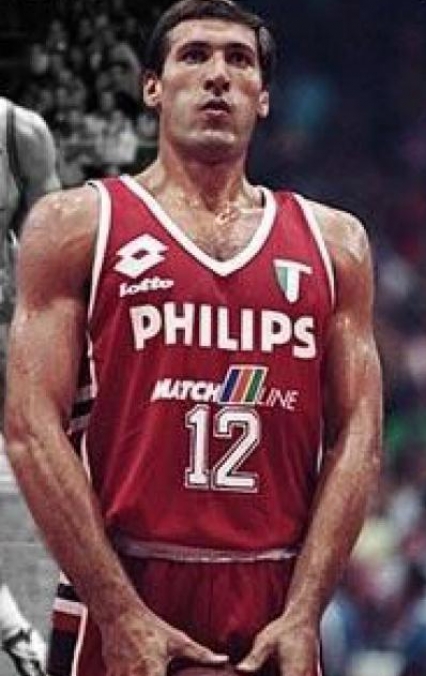
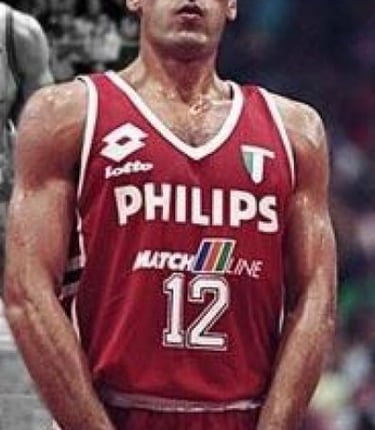
It is widely accepted that in recent years Italian basketball, both at club and national level, has not been going through its finest era. History, however, has written entire chapters about the triumphs of the “Azzurri” during the previous century.
The Italian league used to be the “El Dorado” of European basketball, and the best players of the Old Continent—as well as major names from across the Atlantic—graced Italian courts with their presence, contributing decisively to the establishment of dynasties, the greatest example being the legendary Varese of Meneghin and Morse.
Lombardy, though, had yet another reason to take pride in its dominance of Italian basketball during the 1970s. A short distance from Varese, the team of the small town of Cantù was creating its own myth, winning six European trophies in the two secondary competitions, the Cup Winners’ Cup and the Korać Cup.
In the roster of the 1978 title-winning team, one could find the name of a 16-year-old youngster who, over the course of a glorious 25-year career, would manage to win almost everything, be regarded as the greatest Italian guard in history and one of the finest in Europe. His name was Antonello Riva, although in his homeland his nickname is just as beloved as his real name.
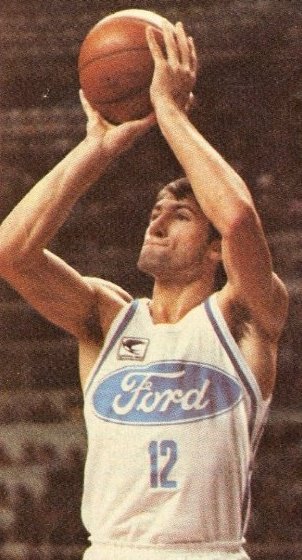
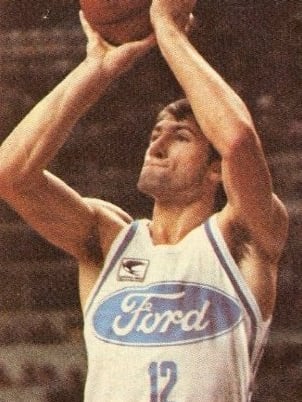
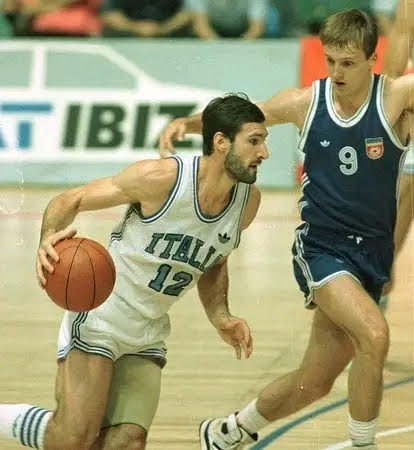
Nembo Kid (Superman in Italian comics, or “Son of the Cloud”) “bombarded” European courts with thousands of points, causing frustration among defenders who tried—most of the time in vain—to stop him. Valerio Bianchini, who had already recognized Riva’s talent at the age of 17, promoted him to the senior team that would win the European Cup Winners’ Cup. In the 1981 final, Antonello, alongside Marzorati and Bariviera, formed an outstanding backcourt trio that, in addition to the European trophy, delivered the Italian championship to Cantù. As champions, they took part in the 1981–82 European Champions Cup, a historic season for the club, which overcame key injuries and the personal tragedy of its coach to reach the final in Cologne.
Maccabi failed to block their path to the top of Europe, and Riva made a decisive contribution with 18 points. The “Biancocelesti” were eliminated in the Italian league quarterfinals by Virtus Bologna, but exercised their right as European champions to compete again in the Champions Cup. I am certain that if someone were to ask Nembo Kid about 1983, he would say it holds a special place in his heart. First, on a personal level, as his son Ivan was born that year. And then professionally, both with Cantù and with the “Squadra Azzurra.”
The Lombard side took revenge on Bologna in the Hitchcock-style final in Grenoble, and Antonello Riva—the top scorer of the Champions Cup—was crowned king of Europe for the second consecutive year. But the “bomber’s” magical season would continue in France at EuroBasket. Sandro Gamba’s Italy, led by Nembo Kid, reached the pinnacle of glory, “forcing” their compatriots to pack Fiumicino Airport to celebrate the champions. At just 21, Riva had Europe at his feet and his entire future ahead of him.
His scoring consistency would be remarkable, though not always rewarded with titles. After the golden two-year spell, Cantù gradually declined, while Italy—following the 1984 Olympic Games, where Antonello was named to the tournament’s All-Star Five—would secure another medal at the EuroBasket in West Germany, this time bronze, in the absence of Nembo Kid due to injury. He returned to his usual standards both at the 1986 FIBA World Championship and at EuroBasket in Athens. The “Philosopher,” Valerio Bianchini, wanted to lift the Azzurri back onto the podium, and Riva was his main weapon. In the quarterfinal—when Galis reportedly sensed from warm-ups that his opponents were not ready to win—Antonello was the only one who looked the “Gangster” in the eye, but to no avail.
The following year, at the Olympic qualifying tournament in the Netherlands, Italy suffered a painful elimination from the Seoul Olympics, and the 26-year-old yet already battle-hardened veteran Riva considered retiring from the national team for the first time. Gamba, who had returned to the helm, managed to convince him to participate in EuroBasket in Zagreb.In Yugoslavia, Nembo Kid arrived after experiencing a major professional change. After 15 full years in Cantù, the local hero changed jerseys. Olimpia Milano broke the bank, and with a fee that in today’s terms exceeded three million euros (we are talking about 1989), he donned the legendary “scarpette rosse.”
The Gabetti family saw in Riva the new leader of the “24th NBA team” and the man who would fill the void left by the simultaneous departures of the three legends: Meneghin, McAdoo, and D’Antoni.Especially after Antonello’s recital on Argentine courts, where although the Squadra Azzurra fell to ninth place, he himself finished second on the World Championship scoring list—behind only his old friend Oscar Schmidt and ahead of Panagiotis Giannakis.
His last appearance with the Azzurri came in the EuroBasket final on home soil in 1991. Riva retired from the national team with a silver medal around his neck and as its all-time leading scorer.Although he was in peak condition, both he and his club were unfortunate in collecting domestic trophies due to the emergence of new forces such as Pesaro and Benetton of Kukoč and Del Negro, as well as the ever-competitive Bologna. In Europe, the once-mighty Milano returned to the Final Four in 1992 in Istanbul as favorites for the semifinal against Obradović’s Partizan.Željko “locked down” Riva with the then-unknown Vladimir Dragutinović, and the “children of war” swept past Milano on their way to glory. The “executioner” of Istanbul, Saša Đorđević, would later move to Milan, and with Antonello as co-pilot they guided Olimpia to the safe harbor of winning the 1993 Korać Cup.
It was the ideal finale for Nembo Kid, who the following year, at 32, sought new challenges. The team that offered them was based in Pesaro, sponsored by the kitchen furniture giant Scavolini. Riva honored that jersey for two years, and in the summer of 1996, despite receiving offers from almost every top-flight team, he chose to spend time in Italy’s A2 division with Goriziana.
At 36, many believed it was time to say goodbye. But Antonello proved them wrong, and in 1998 he returned to the top tier wearing the jersey of his first love. With number 12 on Cantù’s blue shirt, on April 9, 2000, the Superman of Italian basketball scored 19 points against Reggio Emilia and surpassed the “Holy Hand” of Oscar Schmidt, becoming the all-time leading scorer in Italian league history. Shortly before the end, Nembo Kid experienced another emotional moment: in 2004 he shared the court with his 19-year-old son as a teammate. Finally, on November 21 of that same year, the man who once soared among the clouds decided to land and hang up his celebrated jersey at the age of 42.
The “Son of the Cloud” was a giant of European basketball’s golden years. Lightning-fast, highly skilled, strong, and of course an outstanding shooter. A born scorer, he could shoot from anywhere on the court, using his height and his sweet touch. Woe to the defender who gave him even the slightest space to release. In no time, Riva would punish him mercilessly.Valerio Bianchini always praised his fearlessness and leadership when the ball was burning. Thanks to his exceptional physical condition, Antonello starred for a quarter of a century in the demanding Italian league.
He began alongside Marzorati, Meneghin, and Dalipagić; continued with McAdoo, “Sugar” Ray, Kukoč, and Rađa; played both with and against Dejan, Oscar, Danilović, Đorđević, Myers, and Magnifico; and brought his career full circle when players such as Basile and Andrea Meneghin emerged.
For 25 years he made fans wonder whether it was a bird or a plane. The answer? No—it was simply the legendary Nembo Kid.
