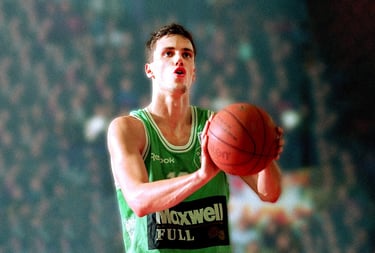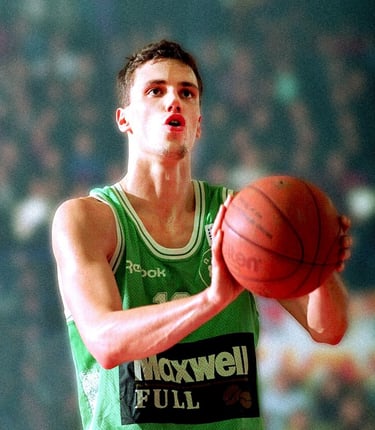
Arijan Komazec
“The heir”
RETROPLAYERS
Antreas Tsemperlidis
12/8/20257 min read


Lets have a look at the below points so that we can fairly judge an iconic player of the 90s, a player who could explode when feeling that he belonged but could also implode just as easily!
At the age of 20, he was the top scorer in the Yugoslav league, and everyone said he was Dražen's successor.
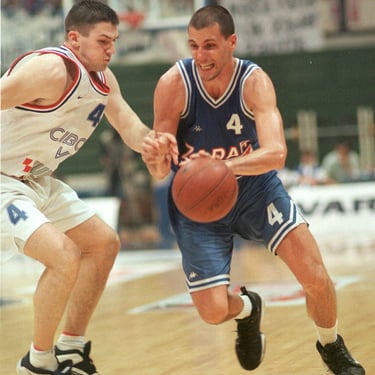
At 21, he was a World and European Champion, at 22 a silver Olympic medalist, and one of the hottest names in European basketball. Expectations were enormous, but Arijan Komazec, was unable to live up to them, except for the two seasons he played in Italy with Varese.
His volatile psychology and inability to show leadership qualities prevented an incredible shooter and scorer like Arijan from having an even more remarkable career.
Not that he had a bad one, though. When, at 16, you play for the first team of Zadar, you're the youngest player in the history of Yugoslav basketball to be called up to the national team (16 years and 10 months), and at 18 you’re a starter aiming for the championship, then something definitely went wrong along the way. A path that started under the best conditions for Komazec, bringing him in 1988 to a season that many would later call the best in the history of the Yugoslav league. Alongside Stojan Vranković and his uncle Petar Popović, Komazec led Zadar to the quarter-finals against the Slovenian team Olimpija Ljubljana.
The series was tight and decided off the court when KSJ punished Komazec before the third and decisive game for missing national team training sessions without justification, thus depriving Zadar of their star who had scored 25 points in the previous two games.
Komazec was no longer the talented kid, but an equal player with the big stars of the league, as shown in the following year, when the season ended with him in fourth place in the scoring table, but out of the final 12 for the EuroBasket in Zagreb, as Ivković preferred Danilović. Determined after the cut, and carrying the weight of an entire stadium (this is no exaggeration—his contract with Zadar in 1989 included, among other provisions, the mortgage of "Jazine" in case of the club's financial insolvency), he became the top scorer in the league with an average of 31 points and was third in the MVP voting. This time, Duda had no excuse not to take him to Argentina for the World Cup. The new star of the Plavi (Yugoslavia) returned to Zadar with the gold medal to find all of Zadar's opponents lining up to sign him.
Cibona, Partizan, Red Star, and Olimpija Ljubljana all made official offers in the summer of 1990, but none came close to the astronomical sums Zadar's management had placed on its most valuable asset. And Komazec himself didn’t push for a move, as he had stated that the only team he wanted to play for outside of Zadar was European Champion Jugoplastika, which never showed interest. Komazec stayed at "Jazine" for the 1990-91 season, making history again by finishing as the top scorer in the last Yugoslav league season as a unified country.
When he returned from Rome on June 30 with the European Champion’s gold medal, he was no longer Yugoslav but Croatian. Amid the war, there were no discussions about sporting activities, so Zadar and Komazec focused on the Korac Cup until March 12, 1992, when the first games of the newly formed Croatian league timidly began.
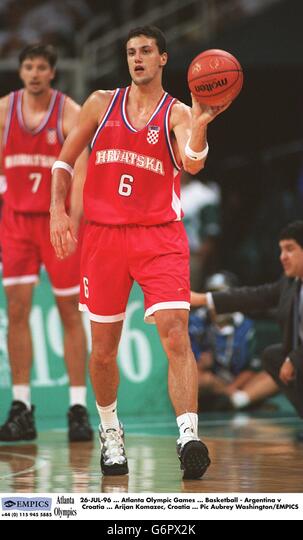
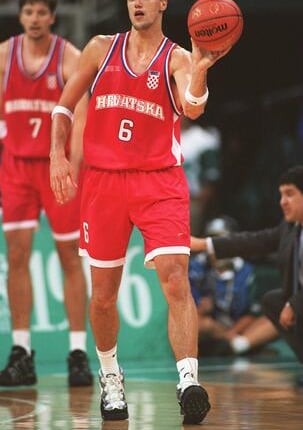
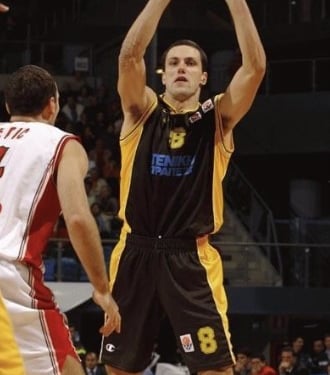
Simultaneously, the first foreign offers began to reach Arijan, with the then Knorr Bologna being the first to express interest in him. However, his future wasn’t in Italy, at least not yet. In the summer of 1992, Pavlos Giannakopoulos, determined to bring Panathinaikos back to the top, spent freely on players like Nikos Galis, Tiit Sokk, and Stojan Vranković. Pavlisevic, however, requested another scorer, with his choice being none other than Arijan, who came to Greece with the silver medal from the Barcelona Olympics. The year in Greece had many ups and downs for the 22-year-old Croatian. While he was consistently the second offensive option for Panathinaikos behind the "Gangster" (and at times the first), the influence of his then-fiancée (who later became his wife), who didn’t want to move to Greece preferring Italy, and rumors of a poor relationship with Nikos Galis, created an increasingly heavy atmosphere for the sensitive Komazec in Athens. Then came the anxiety attack in the locker room, and the sweet moment turned sour as both sides began seeking a way out during the summer of '93.
The solution came through Komazec’s beloved Italy, with historic Varese, who were in the second division and wanted to return to the top flight. In the small and quiet Varese, Komazec found his own earthly paradise, calm and without the pressure of titles, reminding everyone of the Komazec of Zadar. Scoring at will, the "Palasport Lino Oldrini" in the Masnago neighborhood was filled every match by fans who wanted to enjoy the Croatian sharpshooter. Promotion came triumphantly for the legendary team, with Komazec collecting individual awards as top scorer and MVP. Varese, of course, activated the renewal clause with him and never regretted it. In the 1994-95 Italian league season, Komazec did wonders, possibly having the best season of his career.
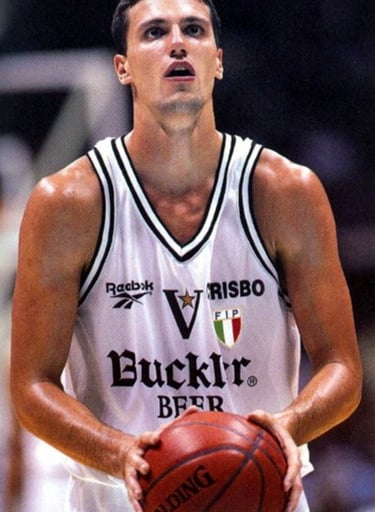
Once again top scorer, once again MVP, 30+ points were bread and butter for him, and the NBA began to take notice. That summer, he was a free agent and in demand across Europe, but he wanted to test himself in the best league. He had discussions with Phoenix, and the Nets, through Willis Reed, approached him, but nothing came of these talks. And so, after the EuroBasket in Athens, he signed with the Buckler Bologna, who were looking for a replacement for Danilović. The Bologna team, amazed by his performances with Varese, quickly offered him a two-year contract, which they would later regret. Despite the team finishing first in the regular season, and Komazec scoring impressive numbers (51 points on December 3, 1995), their elimination in the semi-finals of the playoffs by Stefanel Milano and the crushing defeat of Komazec by Dejan Bodiroga in the finals was the straw that broke the camel’s back. The management and the media openly accused him of being unable to handle the pressure of competing for titles. The honeymoon phase was long over. However, his contract was too strong to break, and both sides had to endure the following season. Komazec was the one who ended the relationship with his decision to undergo ankle surgery, ultimately returning to the playoffs only to experience painful elimination in the semi-finals by their eternal rival, Fortitudo.
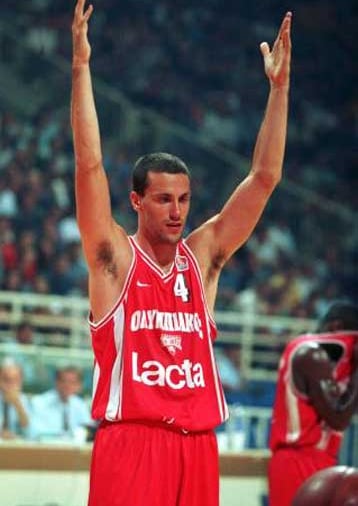
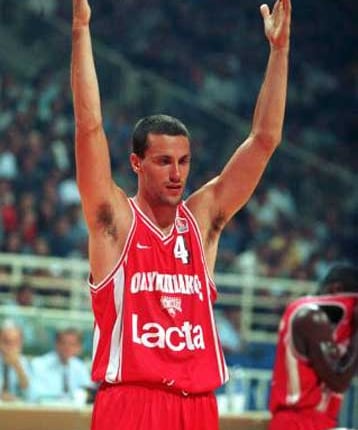
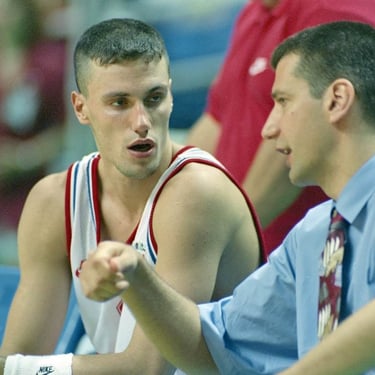
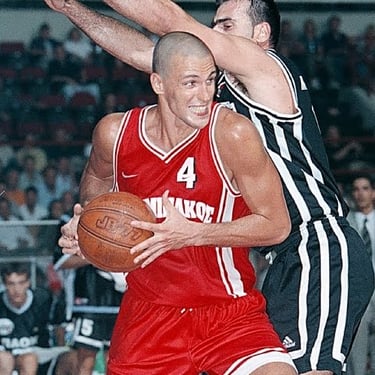
Bologna and Komazec parted ways with relief, Danilović returned to his throne, and Komazec went back to the welcoming arms of Varese. In the familiar environment that provided him security, the Croatian unfolded his talent, even if his averages had dropped, leading the team to qualify for the European Championship after eighteen years. At 28, Komazec had nothing left to prove in Italy. He wanted a club with higher ambitions than Varese and a coach who would trust him. Dusan Ivković, who was looking for a player with Komazec’s qualities—someone who could play as a small forward or shooting guard with excellent long-range shooting—when he learned that Komazec was available, put aside other potential options (Bill Edwards, Mario Eli, and Dale Ellis) and decided to trust his former player from the Yugoslav national team. On July 16, 1998, Komazec, with a newly shaved look, signed a 1+1 year contract and took the red-and-white jersey with the number 4. Everything seemed ideal: Olympiacos had acquired a player in excellent condition with proven scoring ability, and Komazec had the motivation to prove he could carry a team at the highest European level.
Komazec and Olympiacos started well, with the player "getting revenge" on Bologna by scoring 25 points in their matchup, but misfortune struck in November during a game for the Croatian national team in the EuroBasket 1999 qualifiers. Against Bosnia, he injured his surgically repaired ankle, and the MRI showed serious ligament damage. Surgery was inevitable, and his recovery time was estimated at six to eight weeks. He eventually returned to the court after six weeks, on January 16, playing against Maroussi, but the serious injury left its mark. He appeared hesitant and struggled to regain his rhythm. Ivković didn’t use him much initially, possibly wanting to protect him. Even when his playing time gradually increased, Komazec was far from his former self. Olympiacos managed to reach the Final Four, but in the semi-final, the rocket-powered Zalgiris didn’t leave any room, and Komazec was invisible. He was also ineffective in the Greek league finals, failing once again to stop Bodiroga.
In Piraeus, they were not happy with his presence, and there was no intention of renewing his contract. So, Komazec returned to Zadar after eight years, alongside Dino Rađa. Together, they won the Croatian Cup and reached the semi-finals of the Saporta Cup, where they were eliminated by AEK. Suddenly, in the summer of 2000, news emerged that Arijan Komazec was going to the NBA. It caused a stir, as his best years were behind him, but he did receive an offer. Vancouver gave him a non-guaranteed contract for the preseason, and that was it. The NBA chapter for Komazec consisted of two games, seven minutes in total, and one point. Two weeks before the season began, he was cut from the roster, returned to Croatia, and stayed out for the entire 2000-01 season until he was recalled by Dragan Šakota for AEK. Komazec came to Greece for the third time on August 21, 2001, but Greece never suited him. AEK and Komazec had complaints on both sides, and their partnership ended quickly before Christmas. In contrast, his ties to Italy remained strong, and it was no surprise that he chose to end his career there in 2004, with the Avellino jersey.
A gifted shooter and scorer who needed special treatment and an environment where he felt protected, Arijan Komazec wrote his own story in European basketball, but his talents could have certainly taken him further on the path of Europe’s basketball greats...