
Juan Antonio San Epifanio
"Super Epi"
RETROPLAYERS
Antreas Tsemperlidis
3/13/20256 min read
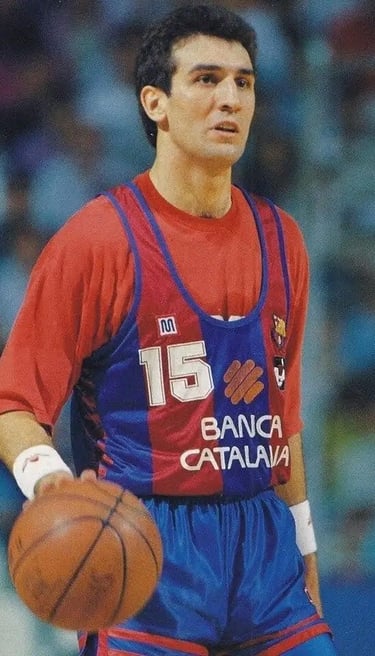
In 2018, one of the last remaining “true” scorers of the European basketball courts, Juan Carlos Navarro, announced his retirement from the game. It was only a matter of time before his jersey would undoubtedly grace the ceiling of Palau Blaugrana alongside those of Solozabal, Jiménez, Dueñas, and the greatest Spaniard in Barça's long history, the legend Juan Antonio San Epifanio, a symbolic player for the Catalans and one of the best European players of the 1980s. Nothing could have predicted that "Epi," born on June 12, 1959, in Zaragoza, would have a career at the highest level. Through the Helios basketball academy, he and his two older brothers had their first contact with the sport. The name of his first coach has been lost to oblivion, probably fortunate for him as his judgment didn't prove particularly sharp... At the time, the Epifanio family's talent was thought to be the eldest brother Herminio, but Juan was not lacking in quality. Despite this, he was cut from the team under the impression that he lacked any serious potential. The young Epi did not give up and continued to train intensively.
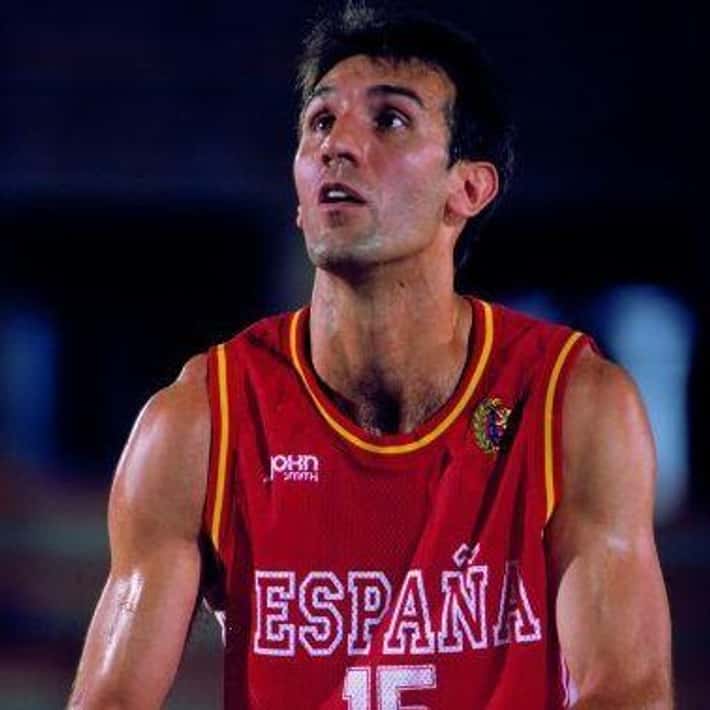
In 1974, Barcelona, eager to break Real Madrid's dominance, acquired European Youth Championship runner-up Herminio San Epifanio, who requested that his younger brother also be transferred to the team. The Catalan board approved and, with the sponsorship of sports equipment for Helios, proceeded to dress-up the young man in the Blaugrana colours, who in turn would eventually become the flagbearer of the basketball department for the next twenty years. Head coach Ranko Zeravica quickly realized the treasure they had unexpectedly acquired, and after just two seasons with the youth team, promoted the young player to the senior team. From 1978 to 1995, the Catalan coaches pinned many of their title hopes on their number 15. National team coach Antonio Diaz followed the Yugoslavian’s example and called-up Epi to the national team for the 1979 EuroBasket. The young player showed maturity beyond his years, averaging 17 points per game, making him the third scorer for "La Roja" behind the great Brabender and Santillana. Barcelona also wanted to turn the page in its history and steal the throne from "La Reina" Real Madrid. The 1978 Copa del Rey was the beginning, and eventually, after 22 long years, the championship came to the Catalan capital in 1981. The protagonist -and hero of this piece- together with Sibilio, formed one of the top backcourt duos in Europe. Their scoring prowess and Epi's height (2.00m) provided a significant advantage to both their coaches of Barcelona and Spain. In three consecutive tournaments (1980 Olympics, 1981 EuroBasket, 1982 World Cup), Spain found themselves in medal contention, ultimately finishing fourth. Epi and Sibilio alternated as top scorers for their team, and after winning another championship with Barça, they were rewarded with the silver medal at the 1983 Nantes EuroBasket. San Epifanio had earned the admiration and respect of all basketball Europe, recognized as one of the best players of his generation. The year 1984 was a pivotal year for Epi. Although they lost the championship to Real Madrid, they reached the European Champions Cup final in Geneva's Patinoire des Vernets, facing Banco Roma led by Larry Wright. Despite Epi's outstanding scoring performance of 31 points, Barcelona lost the game to a second-half comeback from their opponent. Now labelled the top scorer in the Champions Cup, Epi travelled with the national team to the USA for the 1984 Los Angeles Olympics. The Furia Roja surprised everyone by defeating Yugoslavia in the semifinals and playing in the final against the US team featuring Jordan, Malone, and Ewing. Besides the Olympic silver medal, 1984 brought Epi the "Mr. Europa" award as the best player in Europe. At just 25 years old, he had already built a great reputation, with the best years of his career still ahead of him. In 1984, the three-point shot was officially adopted in FIBA competitions, something that proved to be an added weapon to Epi ‘s arsenal. The end of that season saw him become a European Cup winner, a feat repeated the following season with back-to-back victories for the Blaugrana, with Epi starring in both finals.
He continued to score prolifically with the national team, except for the 1988 Olympics, maintaining a streak of fourth-place finishes until the 1990 World Cup in Argentina. In Spain, Barcelona was building its own dynasty with consecutive championships from 1987 to 1990. However, the elusive pinnacle of European Everest remained their secret longing. FIBA's decision to increase the final phase teams from six to eight and the reestablishment of the institution of the Final Four, found the Spanish champions ready for the battle in Ghent. Paradoxically, they were eliminated after two unexpected defeats, first by Aris in Barcelona and then by the towering Germans of Saturn in Cologne. Barcelona and Epi learned their lesson, comfortably qualifying for Munich the following year. However, the youngsters of Jugoplastika would prove to be an unsurmountable obstacle over the following years... They were defeated hands down in the semifinal, while the same script played out in the third-place consolation game against Aris. In Zaragoza in 1990, the scenario repeated itself. Despite being the favourites, they suffered a new blow from the "kids" of Split.
As he approached 33 years of age, San Epifanio saw his playing time gradually decrease. Now, he was a valuable reserve for Barça, coming off the bench to contribute with his excellent long-range shooting. Averaging 19 points in the 1991-92 season, he enjoyed his last season with such impressive numbers. On July 25, 1992, he experienced the most glorious moment of his athletic life. The Spanish Olympic Federation honoured him by selecting him as the final torchbearer at Montjuïc Stadium, before handing the flame to Paralympic archer Antonio Rebollo who would then shoot it into the cauldron. It was San Epifanio's most beautiful memory from the Olympics in his home country. The Spanish national team though failed miserably in the tournament, even suffering an embarrassing defeat to Angola in a crucial game for a top-eight finish. In the celebratory match against the Dream Team, with the entire stadium chanting his name, Díaz inexplicably didn't play him for even a second! In the domestic championship, the landscape had also changed as Badalona and Real Madrid had taken over the reins. The only glimmer of hope was one last Final Four appearance in Tel Aviv in April of 1994 which also ended in defeat.
Epi's curtain call came in the final match of the Spanish championship on May 25, 1995. With 26 seconds remaining, number 15 approached the scorer's table and asked to enter the Palau Blaugrana court one last time. The stadium erupted for the man who honoured the Blaugrana jersey for two decades and by hitting two free throws, he scored the final two of his 8,500 points, closing his illustrious career as the captain of his beloved Barça. San Epifanio was one of the best shooters in European history and among those natural-born scorers whose favourite position to shoot from was the baseline and corner, though he was considered a huge threat from anywhere on the court. A true "killer," who had that instinct, which, if you possess it, you can refine it, but if you don't, you simply can't acquire. The Yugoslav pioneers of shooting knew this well, once nicknaming him "Epifanic." After all, it was a Yugoslavian, Bogdan Tanjević, the first basketball man to spot Epi's great potential, who singled him out at the Santiago de Compostela Youth EuroBasket, saying, "This young man with the Yugoslav wrist will make history." - And indeed, "Super Epi" lived-up to Boša’s prophetic words to the maximum.
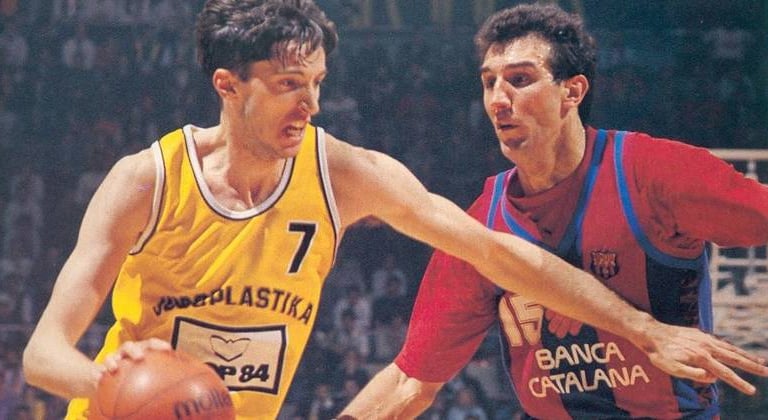
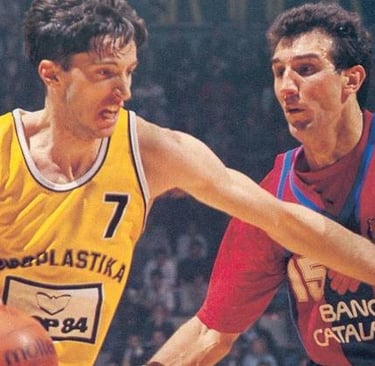


The greatest missed opportunity for the Blaugrana though came at the Paris Final Four. Under the guidance of Europe's best coach at the time, Božidar Maljković, who had twice dealt fatal blows to Barca’s hopes in prior years, Barcelona was arguably also playing the best basketball in Europe at the time. Maljković, with Epi as the team's leader, wants to dethrone his own creation from the European throne and the conditions seemed as ideal as they could get. Now named Pop 84 was the underdog and it seemed outrageous that they would stop the Catalans' march toward the "Holy Grail" of European Basketball. However, in Paris, Kukoč and Savić reminded everyone that their actual name was still Jugoplastika, completing the only 3-peat in modern European Basketball history - other than Gomelski's ASK Riga in the late 1950s. San Epifanio missed his last chance to lift the Champions Cup as a key player and during all of these three Final Four series, Epi, much like his entire team, fell short of expectations. At least 1991 brought him a bronze medal at the Rome EuroBasket with his national team.
