
ΤΗΕ "what if"
Sabas' dominance
RETROMOMENTS
Antreas Tsemperlidis
3/27/20263 min read
The 1986–87 season did not start well at all for the Soviet Union champions, Žalgiris Kaunas, coached by Vladas Garastas. The Lithuanians suffered heavy defeats, such as against SKA in Kyiv (91–72) and Spartak Leningrad, coached by Vladimir Kondrashin (85–69). The main reason for this poor start was the absence, due to injury, of Arvydas Sabonis. At the end of 1986, the “Nature’s Miracle” suffered his first Achilles tendon injury. Then, in the spring of 1987, just before the EuroBasket in Athens, the worst happened: a simultaneous rupture of the cruciate ligaments and the Achilles tendon.
At that time, such an injury essentially meant the end of a basketball player’s career. Perhaps that is why Sabas was allowed to travel to the United States for surgery and rehabilitation, which lasted over six months under the supervision of Robert Cook, a leading orthopedic surgeon and head of the Portland Trail Blazers’ medical staff, who managed to give the Lithuanian giant’s career a second chance. The second and more serious injury might have been avoided if Sabonis had not been burdened with an exhausting number of games with both his club and the USSR national team, as well as the military-style preparations imposed by Gomelsky ahead of international competitions.
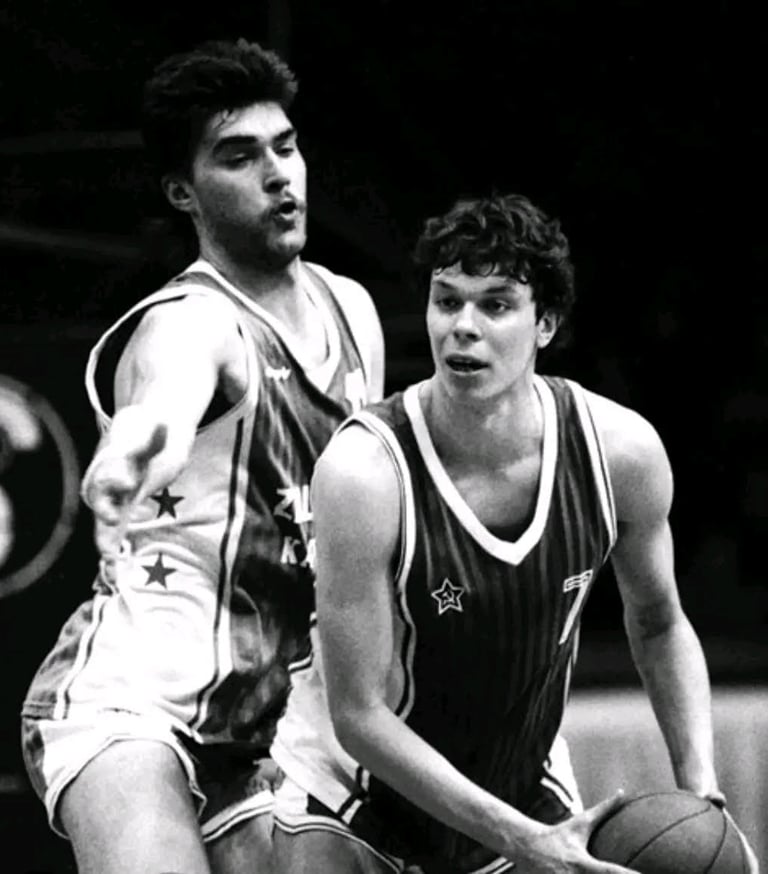
In the end, his legs could not endure it. Despite the successful surgery, Sabonis had to “reinvent” his game. We would never again see the explosive player who shattered the backboard in 1984 at the Madrid Christmas Tournament. From then on, he had to survive the battles in the paint relying on his talent, intelligence, and height.
During the first injury, when a conservative treatment approach was chosen, Sabonis played in very few games that season—only those considered crucial, such as the two league games against CSKA Moscow: the 90–91 away win and the 94–79 victory in Kaunas, where he scored 40 points!!!
Even that was risky. He should have followed a slow and pressure-free rehabilitation, but instead he was competing at the highest level—albeit with some load management, yet still under great demands. Žalgiris Kaunas reached the league finals for the fifth consecutive year, facing CSKA Moscow. The Lithuanians still had a highly talented team even without Sabonis, with players like Chomičius, Rimas Kurtinaitis, Jovaiša, Krapikas, Algirdas Brazys, and Raimundas Čivilis. However, if they wanted to retain their championship title, they needed Arvydas. The first game took place in Kaunas, without the participation of Žalgiris’ center. He did not play for medical reasons, but also by decision of Gomelsky, who controlled Soviet basketball and did not want to risk his participation in the European Championship in Athens. The Red Army team took advantage of his absence and won away 81–92, with outstanding performances from Tkachenko and Alexander Volkov.
In the second game in Moscow, Sabonis was cleared to play. His presence proved decisive, as he was Žalgiris’ top scorer alongside Chomičius, but he particularly stood out defensively against Tkachenko. The away victory (67–70) led to a third and decisive game in Kaunas.
The arena was packed with Lithuanian fans who expected to witness a victory and, consequently, a third consecutive championship against their great rival. It would also be a form of vindication and resistance against the central authority of Moscow, which suppressed the Lithuanian people’s aspirations for independence. Midway through the first half, Yuri Selikhov’s team went on a 19–0 run, taking a significant lead (17–31). As if that were not enough, Sabonis was charged with four fouls before halftime.
Faced with this situation, Garastas decided to risk everything, relying on the long-range shooting of his team’s strong perimeter. In this way, Žalgiris managed to stay in the game and, with the return of a dominant Sabonis (28 points and 25 rebounds), regained the lead and came close to victory. However, an incredible buzzer-beating three-pointer off the backboard by Volkov tied the game at 83–83, sending it into overtime. In the five minutes of overtime, CSKA’s players failed to score a single point. A three-pointer by Kurtinaitis—during a possession in which the Lithuanians grabbed three consecutive offensive rebounds—proved decisive. The final score of 93–83 gave the hosts the win and their third consecutive title, amid wild celebrations by 11,000 fans.
This was the last version of a “dominant” Arvydas Sabonis. The player who appeared in Seoul in September 1988 remained an extraordinary basketball player, but in the eyes of fans, there would always be the question of the greatest “what if” in European basketball history.