
Two champions, one country
A controversy for the ages
RETROMOMENTS
Antreas Tsemperlidis
4/17/20265 min read
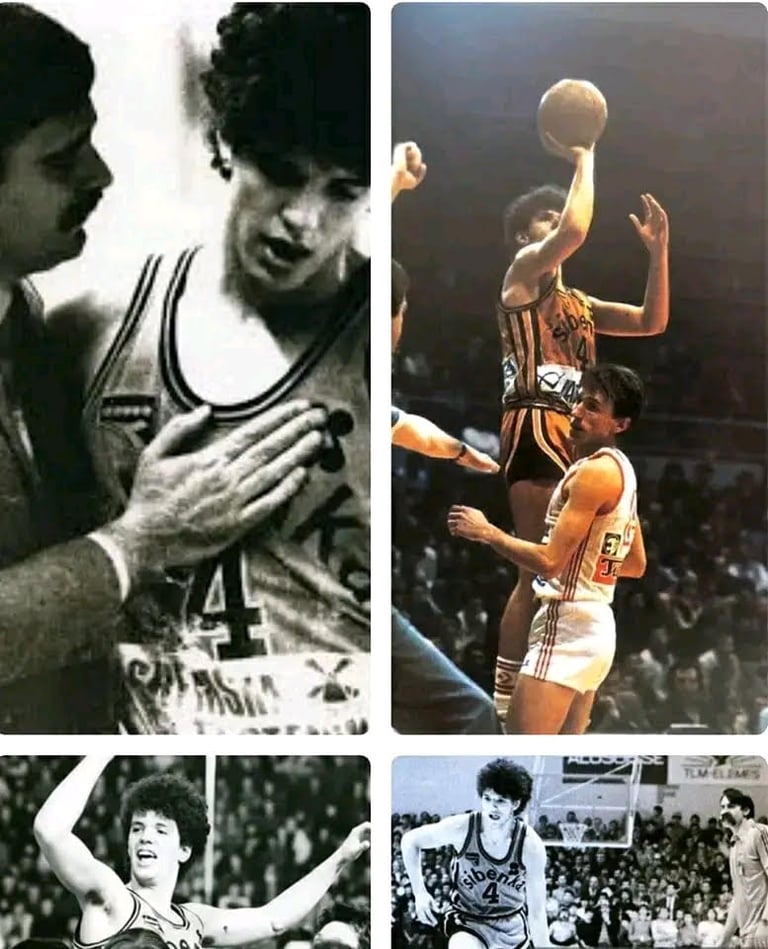
Novi Sad, April 16, 1983. Radovanović and his teammates stand at the center of the court. The referee signals the center of Bosna to come for the opening tip-off. Ratko steps into the circle, the referee tosses the ball into the air, but the only hand that rises to claim it is his own. There is no opponent, no other challenger. On the court, there is only Bosna and its fans celebrating a title that was decided in a game the Bosnians won 20-0 without playing a single second.
At the same time, in Šibenik, on Petar Preradović Street, Dražen Petrović is shooting like a madman at his own basket, as if he were in Novi Sad and the fate of the championship depended on his performance. The championship he was convinced had been stolen from him — which is why he had decided not to show up. He and his Šibenka teammates were the true champions, even if only for fourteen hours, and no one could change that.
Dražen was hungry for titles. The 1983 Korac Cup had slipped away again, just like in 1982, to the French of Limoges. But he was determined to bring the Yugoslav championship to Šibenik. Led by the 19-year-old "Mozart," the Narančasti finished top of the regular season, one win ahead of both Partizan and Bosna. Šibenka overcame Jugoplastika in the quarterfinals, beat Red Star twice in the semifinals, and reached the final against the 1979 European champions. Bosna no longer had Mirza Delibašić or coach Bogdan Tanjević, but the old guard — Radovanović, Varajić, Benacek — remained in Sarajevo, now led by Svetislav Pešić as head coach.
The final series was to be decided by best-of-three (the format introduced in 1981). The two teams split the first two games, each winning at home. The decisive third match would take place in Šibenik, at the Baldekin — Dražen’s fortress and Šibenka’s home.
In front of a packed crowd of 2,000 Croats, with the chant “Si Si Šibenik” shaking the arena, Petrović, along with Branko Macura, Predrag Šarić, Srećko Jarić, and coach Vlada Đurović (known to us as Vlade Đurović), wanted to give the victory and the title to their loyal supporters.
But Bosna was not willing to play the role of the victim and surrender without a fight. The players’ pride reached its peak. Unaffected by the scorching atmosphere, they exploited Šibenka’s irritation and poor shooting, taking a 19-point lead five minutes before halftime.
Đurović trusted his players, especially Dražen, and the latter justified that faith. The “Mozart” played with passion against the team that already considered him their future star — they had even “reserved” him by gifting him a white Golf. But Petrović didn’t care about any of that. After hitting a difficult shot, he turned toward Pešić and showed him a clenched fist. He wanted the championship with the club of his hometown, and he would do anything to win it.
With Sabit Hadžić glued to him all night, Dražen chipped away at the deficit, scoring 38 points — 24 of them in the second half — turning the game back into a derby. With 24 seconds left, Vučević hit a shot from five meters, giving Bosna an 82-81 lead. On Šibenka’s next possession, Dražen missed an off-balance shot. The ball went out of bounds off a Bosna player’s hand, with two seconds remaining on the clock. Živko Ljubojević inbound the ball straight to Dražen. He took two dribbles toward the middle of the paint and, pressured by Hadžić, shot from four meters.
The shot didn’t even touch the rim. It hit the lower part of the backboard exactly as time expired. Bosna’s players began celebrating. Šibenka’s players, led by Dražen, protested furiously.
As referee Ilija Matijević — recognizable by his enormous mustache that resembled Yosemite Sam from the famous cartoon — turned toward the scorers’ table waving his hands to signal the end of the game, Petrović ran toward him, pumping his right shoulder up and down to indicate he had been fouled on the shot.
Chaos erupted on the court. Fans wandered everywhere, players protested or waited, while Matijević and the scorers’ table tried to make sense of the situation. The contact between Dražen and Hadžić was marginal, but a foul was called on Bosna. This intensified the tension. Đurović saw the opportunity and spoke to Petrović. As he later confessed, “Đuro” had realized the call was controversial. Wanting to avoid winning the title in such an unjust manner, he advised his player: “Make the first free throw and miss the second. We’ll win in overtime.” Dražen’s reply left no room for discussion: “No, coach. I’m making both. I want the championship.”
Vlade looked at him, knowing that in Dražen’s mind, he had already made the free throws and claimed the title. Petrović stepped to the line and, with the calmness of a veteran, sank both shots, giving Šibenka an 83-82 victory. The team that had only been promoted to the first division four years earlier was now champion — thanks to this 19-year-old kid with knee-high socks and a wristband on his right arm. That same arm was raised in a clenched fist as he celebrated reaching the top. A top that, unfortunately, would not remain theirs for long.
The next morning, KSJ president Vasil Tupurkovski — who had been at the game and awarded the gold medals to Šibenka’s players — called a meeting at the Federation offices to examine the validity of Matijević’s call and whether time had already expired when the foul was whistled. At noon on Sunday, April 10, 1983, the Federation ruled that the whistle had come after time had run out. Consequently, the victory and the title should be awarded to Bosna. That would have been the logical outcome, but the big shots at KSJ did not agree. Instead, they decided to replay the decisive game on neutral ground — in Novi Sad.
Journalist Vladimir Stanković, then working for the newspaper Borba, called the Petrović family home asking to speak to Dražen. “Šibenka is not the champion,” he said. “You have to play again.” “No,” Petrović replied. “I’m not playing again. I am the champion.”
The news spread quickly across Yugoslavia. Attempts were made to defuse the tension. The mayor of Šibenik called Đurović, implying he had spoken with high-ranking officials, and stressed that the team must comply and travel to Novi Sad. The city was divided. Only one local newspaper captured the situation correctly with the headline: “Dva šampiona, jedna Jugoslavija” (“Two Champions, One Yugoslavia”). It was an unprecedented decision in Yugoslav sports. Never before had such a dilemma arisen. Rumors circulated of political pressure — that Bosna had to win the title because Sarajevo would host the 1984 Winter Olympics — though none of this was ever confirmed. To justify its decision, the KSJ released a manifesto listing eight refereeing errors affecting both teams, signed by Darko Obergnežević (head of the scorers’ table) and the second referee Rade Petrović (Matijević refused to sign). Special emphasis was placed on the final play, essentially shifting all blame onto Matijević, whose refereeing license was revoked. He never officiated again.
On April 15, the Federation rejected Šibenka’s appeal and ordered the team to travel to Novi Sad for the rescheduled third final, warning that failure to appear would result in a 20-0 forfeit and Bosna being declared champion.
The players and Đurović refused to travel. The Croatian basketball federation supported them through its president Ivo Troskot, who stated that, contrary to KSJ announcements, the decision to replay the game had not been unanimous — he himself had voted against it. The title had been decided in a meeting room rather than on the court. Krešimir Ćosić, Josip Đerdža, Mirko Novosel, and the entire Croatian basketball elite stood by Šibenka. But the decision stood. Despite desperate efforts by Matijević, who tried to clear his name by recreating the controversial play with a handheld stopwatch, on April 20 — four days after the farce in Novi Sad — Bosna was officially declared Yugoslav champion for the 1982-83 season.
The gold medals given to the Sarajevo players were newly minted. Their opponents from Šibenka never returned theirs — the ones they had hung around their necks that night at the Baldekin. Dražen’s medal has been on display for years in his museum in Zagreb, a permanent symbol and reminder of the time when one country had two champions.
