
Zoran Sretenović
“From clipboard to court”
RETROPLAYERS
Antreas Tsemperlidis
5/3/20263 min read
When I think of Yugoslav guards of the past, my mind inevitably goes to Dražen and Mirza, Đorđević and Slavnić, Jure Zdovc. Players who combined scoring and playmaking to perfection and could electrify the crowd. But there was also another type: the cerebral playmaker, the quiet worker on the court who didn’t attract the spotlight, yet the coach knew he was an essential cog in the machine. The one who embodied all these traits was the “brain” of the great Jugoplastika, Zoran Sretenović, who passed away suddenly on April 28, 2022, at the age of 58.
Zoran was born in 1964 in Belgrade and, after his first steps in football, turned to basketball at the age of ten. His family home was near Hala Pionir, the arena used by Red Star. He progressed through all the youth levels and, in 1981, after the European Cadet Championship in Katerini, Ranko Žeravica promoted him—along with Aleksandar Milivojica—to the first team.
He didn’t get much playing time; in the guard hierarchy he was behind Radović and Stevan Karadžić. So he devoted countless hours to training, especially individual work, supported by a young assistant coach named Božidar Maljković.Until 1986, his role in a title-contending team like Red Star was limited, and Đurović, who replaced Žeravica, made it clear he didn’t count on him. While Zoran was searching for a new professional home—and even considering early retirement—an offer came from Maljković, who had just taken over Jugoplastika, inviting him to move to Split.
Sretenović didn’t think twice. He was 22 years old and wanted to play, to show his abilities, and “Boža” gave him that opportunity. Maljković saw in Sretenović what Red Star had failed to recognize: a player with a perfect grasp of fundamentals and a mind that worked at incredible speed. He was someone to build around, which is why he was the first signing Maljković requested.
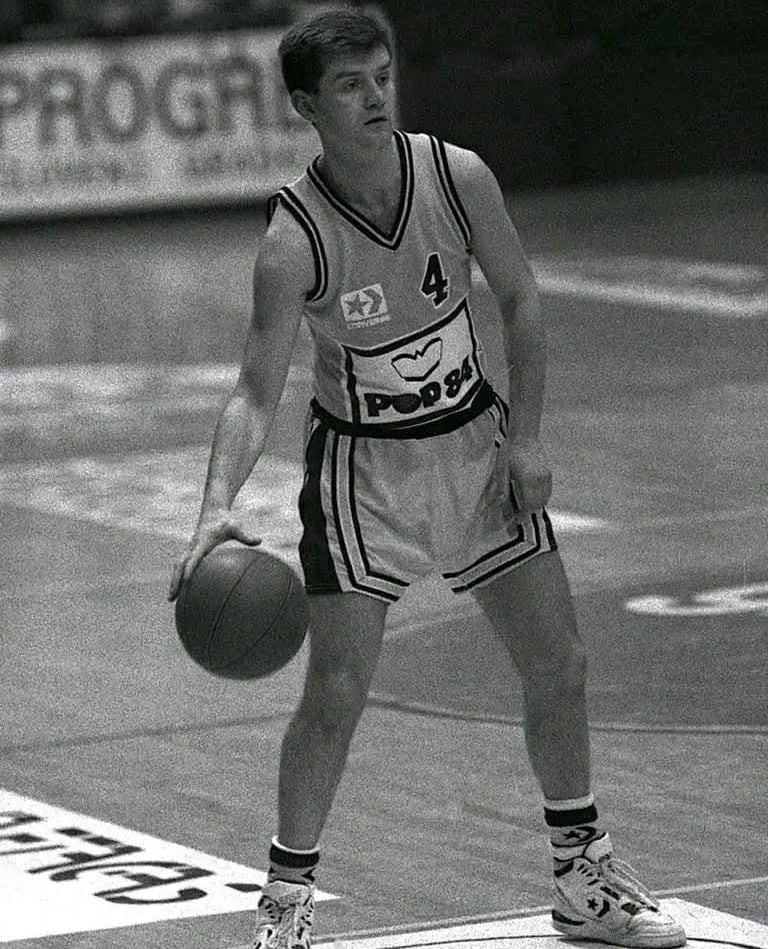
With the promotion of youngsters Kukoč and Rađa, and with Pavićević and Perasović alongside Zoran—and, from the summer of ’87, Ivanović—the “kindergarten of Split” first conquered Yugoslavia and then set out to chase European glory. Almost no one believed in these kids when Jugoplastika went to Munich as the ultimate underdog. No one except Maljković and Nikolić, who had instilled that belief in the players—and it showed on the court at the Olympiahalle.
In the final against Maccabi, Zoran organized the game masterfully and shut down Jamchi in the second half, after he had caused problems earlier.
If Munich was a surprise, Zaragoza was simply confirmation that they were the best team in Europe, unstoppable. They toyed with Limoges in the semifinal, and in the final against the virtually home team Barcelona, they showed what they were made of. Sretenović once again did his job perfectly, while San Epifanio experienced firsthand the defensive abilities of the Yugoslav guard. The following year, everything changed in Zoran’s career and life. Maljković and Ivanović moved to Spain, Dino went to Rome, and Jugoplastika arrived in Paris to defend its title, depleted. And yet?
Pop 84 still carried the aura of European champions and once again bit their favorite victim—the Catalans of Božidar Maljković.
As for number 4 of the “Žuti”? He may not have scored heavily in the semifinal against Scavolini, but he dished out 10 assists, plus 7 more in the final along with the same number of points. At Palais de Bercy, he set an unmatched record that still stands today: he is the only European basketball player to have played all 40 minutes of a final in the top-tier club competition in the Final Four era*. The greatest team in European basketball history took its final bow in Paris, and the sad look during the celebrations of their manager, Josip “Biba” Bilić, said it all about what was to come.
A few weeks later, Ivković included Sretenović in the squad for EuroBasket in Rome, and the man who five years earlier had been surplus at Red Star was now a European champion at both club and international level—celebrating with the flag of a country that no longer existed. As a Serbian, he went to Germany and Bamberg, then to the French Riviera with Antibes, and in 1994 returned to Serbia, wearing the black-and-white of Partizan and Borovica. In the summer of ’95 in Athens, he once again placed the gold medal of European champion around his neck.
He wore Red Star’s red and white again after ten years, played for Radnički, and in 1998 moved to Poland, where he retired in 2001 at the age of 37. Zoran never became a chant on the lips of fans, in discussions about Jugoplastika, his name is rarely mentioned.
Kukoč was the star, Rađa the ruler of the paint, Ivanović the leader. But in Maljković’s mind, the one who translated his tactics from the clipboard onto the court was the brilliant Serbian from Terazije—Zoran Sretenović.
